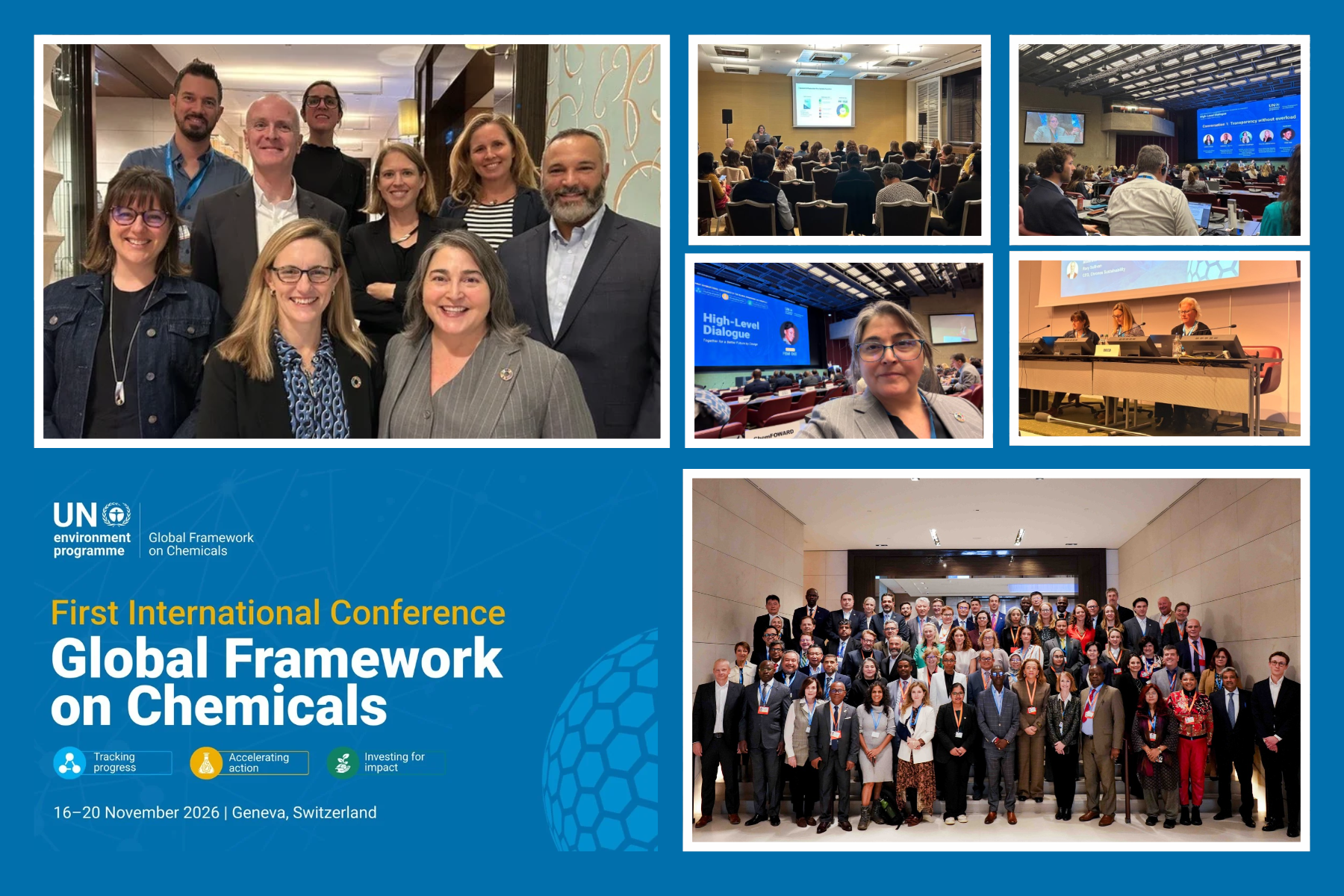
GENEVA, SWITZERLAND — At the First International Conference of the Global Framework on Chemicals (GFC IC1), held November 16–20 in Geneva, nations and global stakeholders took decisive steps to turn the framework's 28 targets into reality—adopting initial global indicators, launching value-chain implementation programs, and extending the GFC Fund.
Representing ChemFORWARD alongside the Safer Chemistry Impact (SCI) Fund and the Investor Environmental Health Network (IEHN), Co-Founder and CEO Stacy Glass joined governments, industry leaders, and investors in Geneva to demonstrate that the practical market infrastructure needed to operationalize safer chemistry is already up and running.
"The GFC establishes 28 ambitious global targets to prevent and minimize harm from chemicals and waste by 2030," said Stacy Glass. "Being in the room in Geneva made one thing unmistakably clear: policymakers and global stakeholders have set the vision, and they are actively looking for practical, scalable market infrastructure to turn those targets into reality on the ground."
Key Highlights from Geneva
Across high-level plenaries, bilateral meetings, and a flagship side event, ChemFORWARD, the SCI Fund, and sector collaboratives positioned shared data infrastructure and standardized metrics at the center of GFC implementation:
Launching the Global Investor Initiative Towards Safer Chemistry (GII): Alongside IEHN, the SCI Fund, and Chronos Sustainability, ChemFORWARD co-hosted "Moving from GFC Targets to Market Action: Operationalizing Safer Chemistry" to formally launch the GII. Joined by representatives from the GFC Secretariat, Google, Target, Dow, BNP Paribas Asset Management, Parnassus, and LWC, the event demonstrated that the three gears required to transition markets—standardized metrics, shared data infrastructure, and capital mobilization—are already operational.
Plenary Intervention on "Transparency Without Overload": During the opening High-Level Dialogue, Stacy Glass delivered a formal intervention and submitted a written statement for the official conference record[cite: 71, 74]. She emphasized that achieving GFC transparency targets (Targets B1 and B2) cannot mean drowning supply chains in fragmented, conflicting Safety Data Sheets[cite: 71, 74]. Instead, ChemFORWARD called on nations to harmonize around proven regulatory best practices, connect digitized baseline data to existing trade and customs systems as a global equalizer, and leverage neutral third-party "translucency" infrastructure—such as the Chemical Hazard Data Trust—to protect intellectual property while unlocking actionable hazard intelligence[cite: 71, 74].
Entering the SCI Metrics Framework into the Official Record: We formally submitted both the Safer Chemistry Impact Metrics Framework v1 and our executive blueprint (A Universal Blueprint for Standardizing Chemical Footprinting and Reporting) to the GFC Secretariat for inclusion in the official conference record and circulation to the GFC measurability and chemical footprinting workstreams
“It’s clear from the first UN conference of the Global Framework on Chemicals that developing nations around the world are increasingly concerned about chemical safety, but the lack of clarity on what alternatives are safe and what metrics to apply is a clear limiter to progress. I see an opportunity for the ChemFORWARD Data Trust and the Safer Chemistry Impact Metrics Framework to level and elevate the hazard knowledge playing field for all.” — David Bourne, Principal Strategist, Sustainability Planning & Portfolio Management, Google
Looking Ahead: A Draft 2030 Commitment for Equitable Access
A central takeaway from Geneva is how essential shared infrastructure is to leveling the playing field between the Global North and Global South. Emerging economies want access to the same verified science that global brands use and consistently warn against unfunded mandates. To anchor its work over the next three years in direct service of the GFC, ChemFORWARD has drafted a 2030 commitment for stakeholder discussion:
Create equitable global access to hazard intelligence—accelerating information sharing, lowering technical barriers, and building capacity so nations with emerging regulatory systems and their innovators can bypass decades of redundant chemical testing, avoid regrettable substitutions, and rapidly adopt safer chemistry.
ChemFORWARD and its partners will support this goal by:
Achieving 90% hazard characterization across four major consumer-facing supply chains;
Embedding standardized safer chemistry metrics and reporting into existing global infrastructure; and
Partnering with the GFC Secretariat to operationalize these tools and accelerate global progress.
Join Us in Moving from Targets to Action
The momentum from Geneva is clear, and the infrastructure to scale safer chemistry is ready for adoption today. Whether you are a brand, supplier, investor, or policymaker, we invite you to help build the standard operating system for safer chemistry.
Join ChemFORWARD and our partners as we advance our 2030 Commitment and move the Safer Chemistry Impact Metrics Framework into formal standards development in early 2027. Explore the full metrics framework, read our GFC IC1 plenary statement, or reach out to join a sector collaborative at chemforward.org.