
First-Ever Industry Baseline Measures the Transition to Safer Chemistry Across Apparel and Footwear Supply Chains
Analysis of 15,000+ apparel and footwear Safety Data Sheets finds a small group of chemicals drives 80% of
reported uses, revealing a more targeted path for industry action
EMBARGO: SEPTEMBER 10, 2026
WASHINGTON, D.C. — After decades of industry investment in restricting known hazardous chemicals in apparel and footwear manufacturing, a new analysis takes the next step: measuring the chemistry known to be used across the supply chain and mapping the transition to safer chemistry over time.
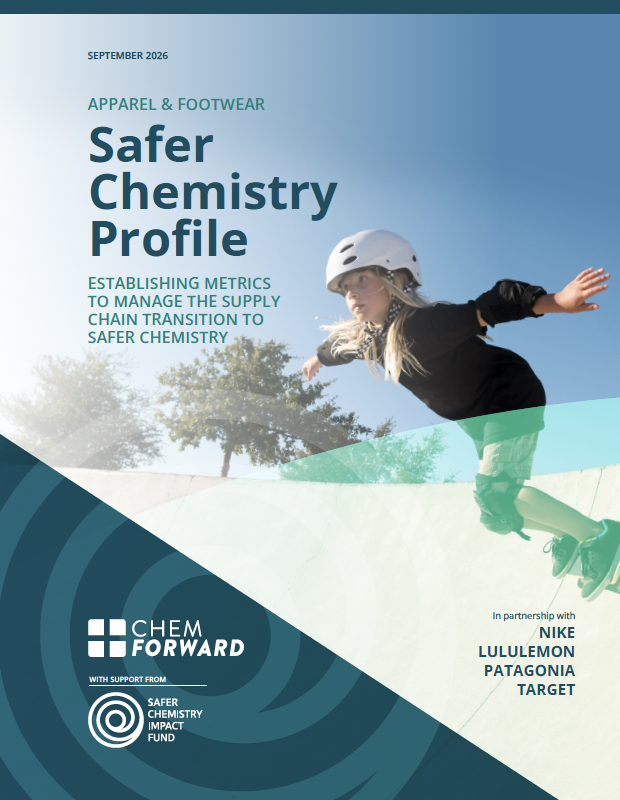
Released today by the Safer Chemistry Impact Fund and ChemFORWARD, the 2026 Apparel & Footwear Safer Chemistry Profile is the first effort to establish a sector-wide, data-driven view of chemicals used across apparel and footwear supply chains. Developed through a year-long effort in partnership with Nike, lululemon, Patagonia, and Target, the analysis measures what is known about chemical hazards, where verified safer chemistry is already in use, and where data gaps remain.
The analysis utilized the open-access Safer Chemistry Impact Metrics Framework paired with the Chemical Hazard Data Trust managed by ChemFORWARD to establish a baseline.
Researchers analyzed more than 15,000 Safety Data Sheets (SDSs) containing nearly 44,000 substance entries. Once duplicates were consolidated, the dataset narrowed to 2,829 unique chemicals. Just 11% of those chemicals accounted for approximately 80% of total uses. This creates an opportunity for brands, suppliers, chemical manufacturers, and industry initiatives to focus hazard assessment, substitution, and innovation efforts on a comparatively small number of high-impact chemicals.
“For decades, the apparel and footwear industry has made important progress by identifying and restricting chemicals we know we don’t want in the supply chain. This baseline gives us the ability to ask the next question: What chemistry are we actually using, and how do we measure whether it is getting safer over time?” said Rachel Simon, Director, Safer Chemistry Decision Intelligence at ChemFORWARD and a co-author of the report.
Accelerating the Transition to Safer Chemistry
This work reflects a leap from evaluating what should be avoided in the supply chain to verifying what IS in the supply chain. It sets the stage for a cycle of continuous improvement through actionable information. Four key recommendations emerge, focusing on actions that can accelerate safer chemistry through improved data, targeted investment, and coordinated industry effort. These include:
Improve Quality and Usability of Chemical Disclosures. Improving data quality is one of the fastest and most scalable ways to expand actionable chemical transparency across the supply chain. Approximately 11% of substance entries— about 4,800 — could not be readily identified because of incorrect CAS numbers or unclear chemical names. By comparison, entries identified as confidential or trade secret accounted for just 1.7% of the dataset.
Expand Hazard Characterization and Share Data to Close Critical Knowledge Gaps. Approximately 59% of identified chemicals in the sector are already characterized based on work other sectors have completed in populating the Chemical Hazard Data Trust. Yet, a meaningful portion (28.1%) remains uncharacterized. Closing knowledge gaps is essential because what is not characterized cannot be effectively managed.
Prioritize Verified Safer Chemistry and Avoid Regrettable Substitutions. The transition to safer chemistry is already underway, with 69% of characterized substances verified as safer options. Industry frameworks such as Restricted Substances Lists (RSLs) and Manufacturing Restricted Substances Lists (MRSLs) have played a critical role in driving this progress by reducing the use of known chemicals of concern. Building on this foundation, the industry is now poised to move beyond “red list” compliance toward proactive, data-driven verification of safer chemicals across the supply chain.
Address Chemicals of Concern and Activate the Innovation Ecosystem.
Identifying chemicals with Hazard Band D or F scores provides a starting point for proactive decision-making rather than a simple endpoint. These metrics should be used to signal where innovation or deeper risk management is required.
“The science and tools to understand chemical hazards already exist for a significant
share of the chemistry being used. The opportunity now is to make the information
moving through the supply chain more consistent and usable so companies can
connect that knowledge to decisions,” said Simon.
The full 2026 Apparel & Footwear Safer Chemistry Profile is available HERE.
About ChemFORWARD
ChemFORWARD is a science-based, nonprofit organization working to create
broad access to chemical hazard data to end the uncertainty about chemical
hazards by ensuring that all chemicals entering commerce are well characterized
and support safe and sustainable design. Utilizing a data-sharing model, the
Chemical Hazard Data Trust managed by ChemFORWARD offers users trusted
information on comprehensive chemical hazard assessments with a focus on
safer alternatives.
About the Safer Chemistry Impact Fund
The Safer Chemistry Impact Fund is a multi-stakeholder initiative created to mobilize
global investment for systematically replacing hazardous chemicals with alternatives
that are verified to be safer for humans and the environment. The collaborative effort
works to identify, fund, scale, and measure impact solutions that embed safer
chemistry across supply chains as the standard operating system.