

Google Recommends pfasID.org for Supply Chain PFAS Screening
A New Easy-to-Adopt Framework for "Forever Chemicals" Management
In a significant move for sustainable chemistry, Google has integrated pfasID.org into its 2025 Restricted Substances Specification.
As regulatory frameworks struggle to keep pace with chemical innovation, list-based screening alone is no longer sufficient to prevent environmental and health risks. Through this update, Google is moving its supply chain past reactive compliance and firmly into the era of proactive, safe-by-design chemistry.
Under Section 9 (Safer Chemistry Requirements) of the new specification, Google requires its suppliers to restrict Per- and Polyfluoroalkyl Substances (PFAS) across all materials to a strict limit of 25 ppb. Crucially, the scope of this restriction explicitly includes, but is not limited to, substances defined as PFAS by the pfasID.org tool.
By incorporating pfasID into its specification, Google is encouraging its suppliers to adopt a more comprehensive approach to PFAS screening and to ensure that PFAS hazards are identified early in the design phase. As a free, web-based tool, pfasID evaluates chemicals using both authoritative regulatory lists and structural identification methods via SMILES-based chemistry screening.
The specification also establishes a stronger framework for supplier accountability. Suppliers seeking to use any identified PFAS must now undergo a rigorous preauthorization process that requires them to provide technical justification and a concrete timeline for safer substitution.
How to Integrate pfasID into Your Chemical Management Program
Organizations looking to strengthen their chemical management strategies can use Google’s Section 9 framework as a model for establishing a robust defense against regrettable substitution.
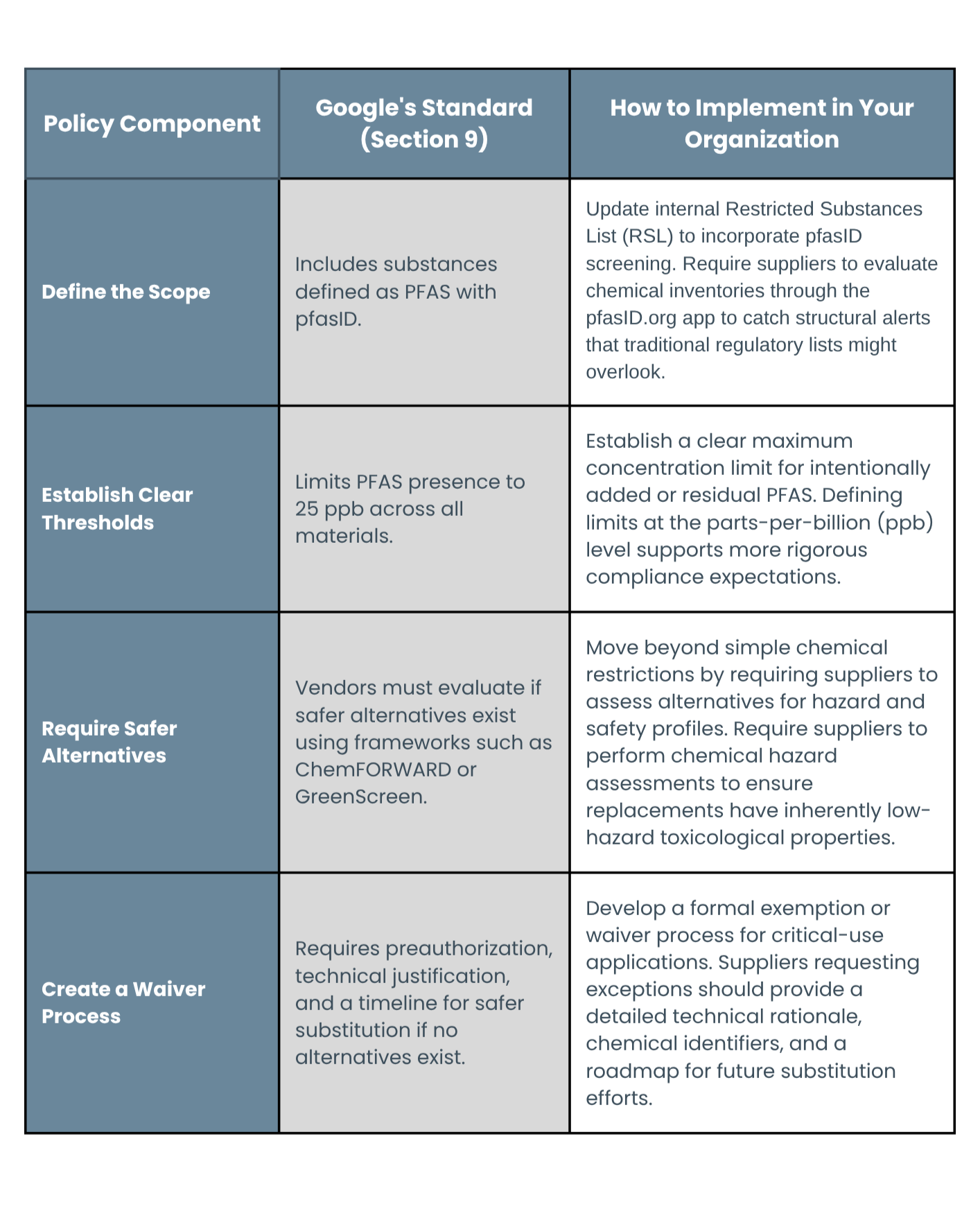
The chart on the right offers a step-by-step guide to integrating pfasID screening into your enterprise standards.
By embedding tools like pfasID into your core compliance and chemical management workflows, your supply chain can significantly reduce the risks of environmental contamination and health impacts.