


NEWS
know better chemistry

ChemFORWARD and the Cradle to Cradle Products Innovation Institute are working together to embed the Cradle to Cradle Certified™ Product Standard Material Health methodology into the ChemFORWARD repository.
ChemFORWARD, which is building the first globally harmonized repository of chemical hazard assessments and alternatives, will use the C2C Certified Material Health methodology to offer companies a uniquely powerful tool for optimizing the material health of their products.

ChemFORWARD is excited to participate in a webinar discussing safer product innovation with the Environmental Defense Fund on Dec. 17. Dr. Lauren Heine, ChemFORWARD’s director of safer materials & data integrity, and Stacy Glass, executive director, will join Alissa Sasso for a conversation about innovating safer ingredients and products, allowing companies to stay ahead of regulatory scrutiny, manage business risk and build consumer trust.

ChemFORWARD is pleased to announce that its first portfolio of data on alternatives to ortho-phthalate, which are often referred to simply as phthalate, plasticizers of concern has been posted and is available for subscription. The organization’s initial pilot project compiled hazard assessments for 10 safer plasticizers.

ChemFORWARD has selected its first pilot program, assessing alternatives for ortho-phthalates of concern. Phthalates are used as plasticisers in materials from vinyl flooring to food-service gloves. The pilot will assemble a portfolio of full hazard assessments viewable in multiple hazard formats including the Globally Harmonized System of Classification and Labelling of Chemicals and the Cradle to Cradle Material Health Methodology. The portfolio will offer manufacturers the first repository of comparable information to make decisions about their use. The pilot also features a secure platform to access the information and a fair, equitable structure for sharing the expense of comprehensive assessments to reduce overall cost.

Iconic sneaker and apparel producer Nike has released an open-source circular design guide, created to give its fashion-industry peers a common language for sustainable design. The guide highlights ChemFORWARD as a source for hazard data and safer alternatives that unlock the economic potential of the circular economy.

Heine brings decades of experience and leadership in green chemistry and engineering, alternatives assessment and multi-stakeholder collaboration which will accelerate ChemFORWARD’s efforts to enable a prosperous, toxic-free future for people, the planet and commerce. She is the ideal technical leader to drive ChemFORWARD’s mission to equip industry leaders who want to do the right thing with reliable access to authoritative material health data.

Through the partnership, H&M will help ChemFORWARD refine and scale its chemical-hazard screening and assessment tools to be the most trusted source of verified, actionable data available to the fashion industry as well as other global manufacturers.

The new modules feature ChemFORWARD’S free screening tool, MaterialWise powered by the Healthy Building Network’s Pharos database. The tool offers users full access to more than 100,000 known chemicals of concern, along with information about common uses and exposures and why certain hazards matter. Modules guide users in such undertakings as running their own product-redesign workshop or shifting an organization’s business strategy to prioritize material health.
Google and the Ellen MacArthur Foundation have released a new paper discussing the role of safer chemistry and better materials selection in the circular economy. The paper identifies MaterialWise a precursor to ChemFORWARD as a leader in providing the transparent, verified, and affordable data manufacturers need to make products suited for the circular economy.
Safer Chemistry
in the News
DURHAM, N.C. — Ahead of a major United Nations chemicals conference in November, the largest-ever analysis of the chemical footprint of beauty and personal care products reveals opportunities to strengthen chemical management policy, including on endocrine-disrupting chemicals, while showing how the industry can measure its transition to safer ingredients.
The Know Better, Do Better (KBDB) Collaborative, an industry-led initiative managed by ChemFORWARD, today released its 2026 Beauty & Personal Care Safer Chemistry Profile. The analysis examines nearly 2.9 million ingredient occurrences across 156,594 products commercially available in the U.S., more than tripling the number of products analyzed last year. Among the findings, researchers identified 19 potential endocrine-disrupting chemicals, as defined in the report, and new scientific evidence that changed the hazard classifications of two widely used ingredients.
Following last week’s landmark launch of the Safer Chemistry Impact Metrics Framework by the Safer Chemistry Impact Fund, ChemFORWARD is proud to announce the next evolution of our portfolio assessment services: the Safer Chemistry Profile (SCP) (formerly known as the Ingredient Intelligence Report).
At the upcoming Society of Toxicology (SOT) 65th Annual Meeting, leaders from the science-based nonprofit ChemFORWARD will present a data-driven solution aimed at accelerating the adoption of safer chemistry in household and industrial cleaners.
ChemFORWARD today announced the introduction of the Chemical Hazard Data Trust, a groundbreaking public interest initiative designed to transform access to reliable chemical hazard information and accelerate the global transition to safer, more sustainable products.

The global challenge of Per- and Polyfluoroalkyl Substances (PFAS)—the persistent "forever chemicals"—can feel overwhelming.
They are ubiquitous and persistent, and removing them from the environment is often complex and prohibitively expensive.
What if the most powerful step toward a cleaner future isn’t years of invention and innovation - but a simple, strategic action at the very beginning of your journey?

We're excited to announce the release of the new Planet Tracker report, "Toxic Additives: Analysing Product Portfolio Risk," which underscores the critical role of ChemFORWARD in bringing much-needed hazard transparency and safer alternatives to the plastics value chain.
Perspectives

Every chemical should have hazard data publicly available. Hazard is an inherent property of an ingredient, and refers to its ability to cause harm, whereas exposure is how you come into contact with the chemical. (Hazard + exposure = risk)

Consumers and producers often assume that “natural” means “safe,” sometimes without adequate information. Beauty Matter has published this article by ChemFORWARD, examining the rapidly growing field of botanical ingredients.

“Clean” has grown to dominate the growth in the beauty sector, with prestige beauty brands claiming to be clean surging 39 percent in 2019 and doubling their share of high-end skincare sales in the last four years.
ChemFORWARD Executive Director Stacy Glass sat down to talk with Boma Brown-West, director of consumer health at Environmental Defense Fund. Brown-West is an engineer who works at the intersection of science, policy and corporate leadership to drive safer products in the retail marketplace. Glass leads a nongovernmental organization working to provide a shared database of chemical hazards and safer alternatives, allowing companies to use better information to make safer products.
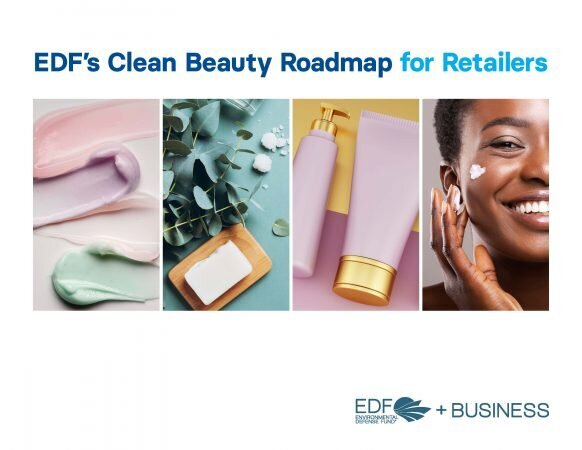
This roadmap is a clear framework for companies making clean beauty claims to restore and build confidence in their products. It equips them to move beyond the practice of claiming to be “free of” a group of hazards or restricted substances -- no matter how extensive -- and instead offer the credible assurance that ingredients have been thoroughly and credibly assessed and found to be free of hazards.

ChemFORWARD’s team of seasoned safe-chemistry pioneers built this platform to offer an easy way to create safer beauty and personal care products which demonstrate leadership in this industry. The tool offers a simple, intuitive, and affordable route to eliminating chemicals of concern, avoiding regrettable substitutions, and designing safer from the beginning.

Bartlett has worked with ChemFORWARD as a consultant and verifier and will now add this leadership role to those duties. He will help ChemFORWARD advance the development and adoption of its platform as well as provide valuable judgment to ChemFORWARD’s unique verification and technical dispute resolution process, ensuring the highest quality data makes it onto the platform.
ChemFORWARD hosted a series of virtual coffee breaks featuring leaders from clean Beauty and Personal Care. These 30-minute sessions offered a targeted introduction to ideas you’ll want to explore further along with meaningful, provocative conversation.
Announcements
Following last week’s landmark launch of the Safer Chemistry Impact Metrics Framework by the Safer Chemistry Impact Fund, ChemFORWARD is proud to announce the next evolution of our portfolio assessment services: the Safer Chemistry Profile (SCP) (formerly known as the Ingredient Intelligence Report).

A New Easy-to-Adopt Framework for "Forever Chemicals" Management
In a significant move for sustainable chemistry, Google has integrated pfasID.org into its 2025 Restricted Substances Specification.
At the upcoming Society of Toxicology (SOT) 65th Annual Meeting, leaders from the science-based nonprofit ChemFORWARD will present a data-driven solution aimed at accelerating the adoption of safer chemistry in household and industrial cleaners.
ChemFORWARD today announced the introduction of the Chemical Hazard Data Trust, a groundbreaking public interest initiative designed to transform access to reliable chemical hazard information and accelerate the global transition to safer, more sustainable products.
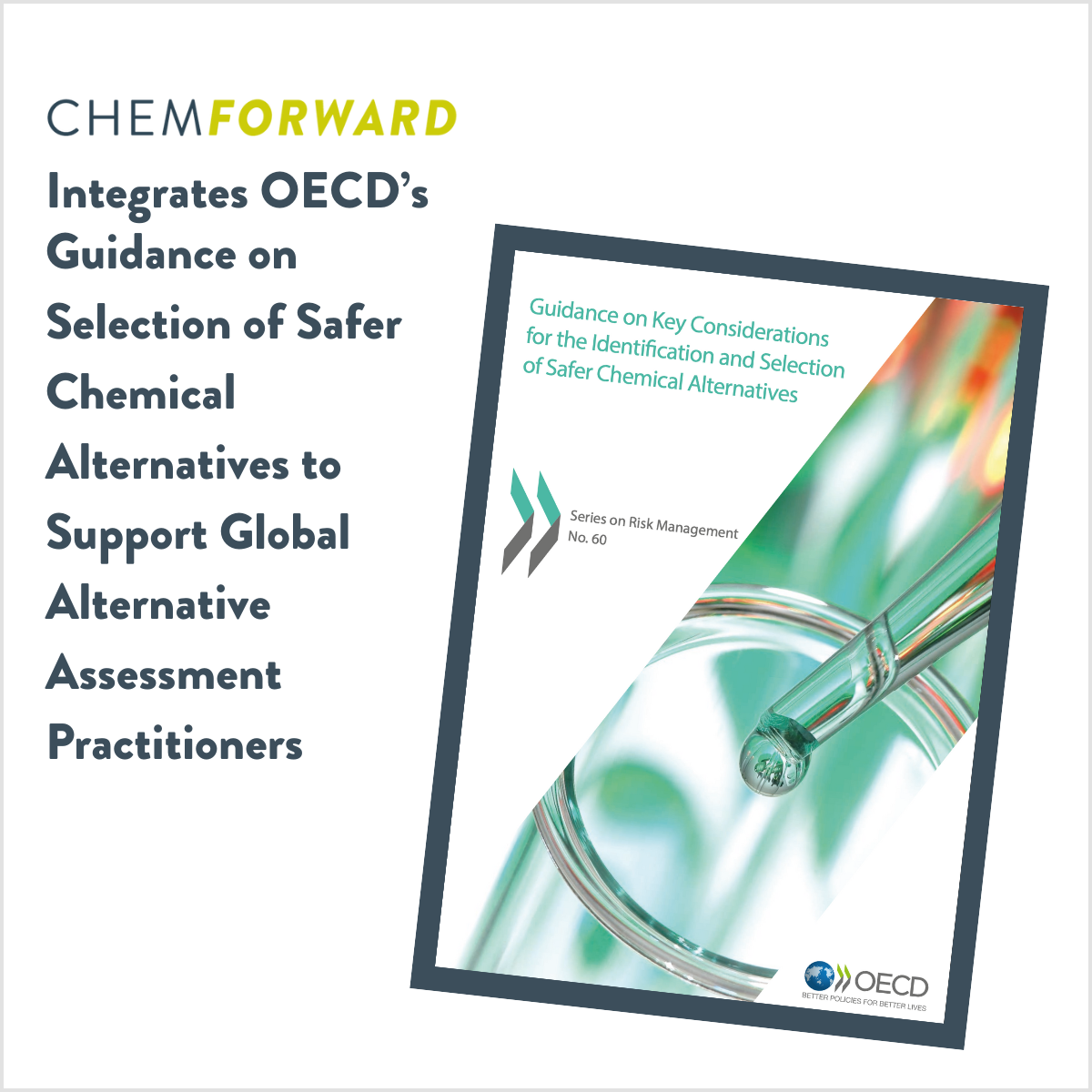
Today, ChemFORWARD announced new enhancements to their web-based platform that operationalize and integrate the application of OECD’s Guidance on Key Considerations for the Identification and Selection of Safer Chemical Alternatives.

ChemFORWARD is proud to announce that Hong Lin has joined our team as a Program Manager - Industry Collaboratives. With her deep expertise in regulatory science and safer chemistry, Hong will be a key leader in driving the growth and impact of our cross-sector collaboratives.
Josh brings a wealth of experience in managing scalable software projects and a proven track record of guiding highly complex projects to success. From startups to the largest global enterprises, his key strength is cultivating user-centered design and engagement by being proactive with customers and end-users, foundations of success for ChemFORWARD.